Views: 0 Author: Yang Publish Time: 2026-09-03 Origin: Site


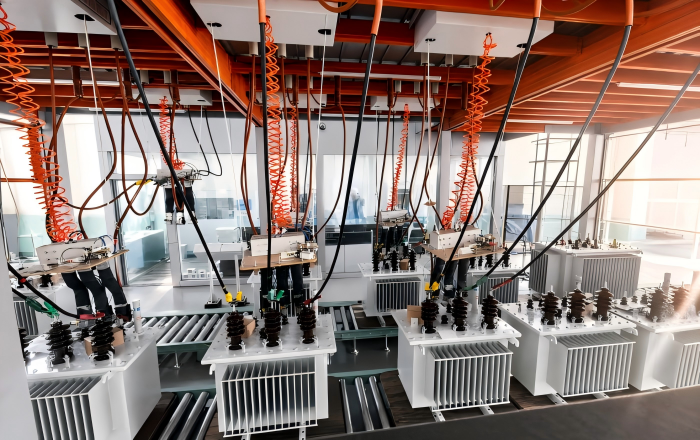
Oil cooled transformer(Oil Immersed Transformer)in which insulating oil is used as a cooling medium and electrical insulating medium.
In operation heat is produced in the windings by the current passing through them and in the iron core by the core losses. If this heat is not removed efficiently, high temperatures can increase the aging of the insulation and reduce the transformer service life.
Oil-filled transformers have their iron core and windings submerged in insulating oil. The oil takes the heat produced inside the transformer and carries it to the tank and cooling system of the transformer. Depending on the transformer design, the heat is then dissipated by radiators, cooling fans, heat exchangers or other cooling equipment.
The main components typically include:
Component | Main Function |
Magnetic Core | Provides the magnetic circuit for voltage transformation |
Windings | Transfer electrical energy between voltage levels |
Transformer Oil | Provides insulation and transfers heat |
Transformer Tank | Contains the core, windings, and insulating oil |
Radiators | Increase the heat dissipation area |
Bushings | Provide insulated electrical connections |
Conservator Tank | Accommodates changes in oil volume |
Breather | Helps control moisture entering the conservator |
Tap Changer | Adjusts the transformer voltage ratio |
Protection Devices | Monitor pressure, temperature, oil level, and other operating conditions |
Transformer oil quality and condition are essential for reliable long-term operation as the oil performs both cooling and insulating functions .
The basic principle on which an oil cooled transformer operates is electromagnetic induction. An alternating voltage applied to the primary winding creates an alternating magnetic flux in the transformer core which, in turn, induces a voltage in the secondary winding. At the same time electrical and magnetic losses heat up.
This is what the cooling process generally looks like:
Core & Windings → Transformer Oil → Tank/Radiators → Ambient Air
The oil takes heat from the core and windings. The heated oil is circulated by natural or forced circulation to cooler areas as the oil temperature increases. Then, the heat is dissipated to the surrounding environment through the surfaces of the transformer tank or radiators. This process enables the transformer to operate in a proper temperature range.
Core and Windings
Magnetic cores are usually made from high quality electrical steel to minimize iron losses. Windings are made to the required voltage, current, insulation class and transformer capacity.
The design of the core and windings directly influence:
No-load losses
Load losses
Temperature rise
Efficiency
Short-circuit strength
Service life
Transformer Oil
There are two essential functions of transformer oil.
1. Electrical insulation
Oil also serves to improve the dielectric strength between energized components and between the windings and the grounded transformer tank.
2. Thermal transfer
The oil transports heat from the core and windings to the cooling surfaces.
This combination makes oil cooled technology especially valuable for transformers operating at higher capacities.

Depending on the transformer capacity, operating conditions, installation requirements and project specifications, different cooling systems are used.
ONAN means: Oil Natural Air Natural
The transformer oil is circulated naturally by temperature difference inside the tank and heat is dissipated naturally into the surrounding air.
The ONAN (Oil-Immersed Natural-Air-Cooled) method is extensively used for distribution transformers and many medium capacity transformers, due to its simple construction, low maintenance requirements and reliable operation.
Advantages of ONAN Cooling:
Simple design
No cooling pump required
No cooling fan required under normal conditions
Lower maintenance requirements
High reliability
Suitable for many outdoor distribution applications
ONAF means: Oil Natural Air Forced
The oil circulation is natural but fans are fitted to force air through the radiator.
The ONAF method provides better heat dissipation than the ONAN cooling method, which means that the same physical size transformer can carry higher loads or be of larger capacity.
This cooling method is normally used for large distribution transformers and power transformers.
OFAF means: Oil Forced Air Forced
The transformer oil is circulated by an oil pump. Fans are used to force air over the cooling radiators or heat exchangers.
This arrangement gives more cooling capacity and is used for large power transformers where the natural circulation of oil is not enough to fulfilll the cooling requirements.
OFWF means: Oil Forced Water Forced
This type of cooling uses oil to flow through a heat exchanger . Water is used to dissipate the heat .
The OFWF system is suitable for large capacity transformers and some industrial or power applications, i.e. where normal air cooling is not satisfactory or where it is desirable to have water cooling due to installation conditions.
Cooling Method | Oil Circulation | Cooling Medium | Typical Application |
ONAN | Natural | Natural Air | Distribution Transformers |
ONAF | Natural | Forced Air | Medium/High Capacity |
OFAF | Forced | Forced Air | Large Power Transformers |
OFWF | Forced | Forced Water | Large/Specialized Applications |
For most conventional distribution transformer applications ONAN cooling provides a practical balance of reliability, simplicity and cost. Larger projects may require more complex cooling systems.
Oil cooled technology is often a good choice when:
1. Requires large capacity
2. To be installed in outdoor
3. Efficient heat dissipation is essential
4.The project comprises a utility substation.
5. The transformer will be working with heavy load all the time
6.A long service life is a priority
7. The installation environment permits oil-filled equipment.
Why Choose Oil Cooled Transformer?
Dry type transformers are preferred when indoor installation, fire safety, space limitations or specific environmental requirements are more important.
Electric utilities use oil-cooled distribution transformers to reduce medium-voltage electricity to levels used by residential, commercial and industrial consumers.
Typical applications include:
Distribution substations
Utility networks
Rural electrification
Industrial distribution systems
Manufacturing plants often need transformers to convert medium-voltage utility power into usable low-voltage electricity.
Applications include:
Manufacturing plants
Steel mills
Mining facilities
Chemical plants
Machinery factories
Processing facilities
Solar farms have photovoltaic systems that generate electricity. Transformers are needed to collect and change the electricity so that it can be connected to a medium- or high-voltage grid.
Oil cooled transformers are widely considered for:
Solar power plants
PV collection systems
Step-up transformer applications
Renewable energy substations
Wind farms also need transformers to step up the voltage they produce so that it can be transmitted efficiently.
Oil cooled transformer solutions can be used in:
Wind farms
Wind turbine transformer systems
Collection substations
Grid connection projects
Depending on local requirements, oil cooled transformers can also be used in large infrastructure projects where outdoor substations and reliable medium voltage distribution are needed.
A systematic review of electrical and environmental needs requires the selection of an appropriate transformer.
Step 1: Determine How Much You Need
The first step is to find the required transformer capacity.
The typical ratings are: 100 kVA, 160 kVA, 250 kVA, 315 kVA, 400 kVA, 500 kVA, 630 kVA, 800 kVA, 1000 kVA, 1250 kVA, 1600 kVA, 2000 kVA, 2500 kVA
High MVA ratings for large power applications
The transformer should not be selected on the basis of today’s load only. Other considerations include future load growth, starting currents, seasonal variations and required operating margins.
Step 2: Find the High-Voltage Level
The primary voltage must be compatible with the upstream power system.
The medium voltage levels are usually: 6.6 kV 10 kV 11 kV 13.8 kV 20 kV 22 kV 33 kV 35 kV
The actual voltage should always be taken from the local grid and project specifications.
Step 3: Identify the low-voltage level
The secondary voltage is dependant on the downstream electrical system.
For instance, local regulations and equipment requirements may differ between industrial and commercial projects, and different LV configurations may be required.
Step 4: Choose the Cooling Method
ONAN is good for many standard distribution applications.
Larger transformers may need: ONAF, OFAF, OFWF
The choice of a transformer is based on its capacity, temperature rise, ambient conditions and project specifications.
Step 5: Find the Vector Group
The vector group describes the relation between the primary and secondary winding connections and phase displacement.
Typical configurations are: YNd11, Yyn0, Dyn11
The vector group must be compatible with the existing electrical grid.
Step 6: Think About the Install Environment
Important environmental factors include:
Ambient temperature
Altitude
Humidity
Dust
Salt spray
Coastal conditions
Outdoor or indoor installation
Solar radiation
Ventilation
Seismic conditions
For projects situated in hot climates or at high altitudes, transformer design may have to be modified accordingly.
Step 7: Identify the Relevant Standards
The transformer shall be manufactured and tested as per project specified standards.
Depending on the target market, buyers may require IEC, IEEE/ANSI or applicable local standards.
Before placing an order, B2B buyers should review the complete technical specification rather than focusing only on transformer capacity.
Specification | What Buyers Should Check |
Rated Power | kVA or MVA |
HV Voltage | Primary rated voltage |
LV Voltage | Secondary rated voltage |
Frequency | 50 Hz or 60 Hz |
Phase | Single-phase or three-phase |
Cooling | ONAN, ONAF, OFAF, etc. |
Vector Group | Example: Dyn11 |
Impedance | Percentage impedance |
No-load Loss | Core loss |
Load Loss | Winding/load loss |
Temperature Rise | Maximum allowable rise |
Insulation Level | According to applicable standard |
Tap Changer | Off-circuit or on-load |
Transformer Oil | Mineral or ester-based |
Installation | Indoor/outdoor |
Accessories | Required protection and monitoring devices |
A professional transformer supplier should be able to provide a detailed technical datasheet before order confirmation.
There is no one standard price for an Oil Cooled Transformer, as the final cost depends on technical specifications and project requirements.
The main cost factors are:
1. Capacity of Transformer
The construction and materials of a 100 kVA transformer and a 5 MVA transformer are vastly different.
2. Voltage Level
Transformers of higher voltages generally need more sophisticated insulation systems and components.
3. Core Material
The losses and cost of the transformer are directly affected by the quality and design of the core steel.
4. Wire, winding
The electrical, mechanical and the cost characteristics of copper and aluminum windings are different.
5. Cooling System
ONAN systems are generally simpler than forced air cooling systems.
6. Tap chager
The costs of an off-circuit tap changer and an on-load tap changer can be quite different.
7. Requirements regarding efficiency
Transformers with low losses may need more optimized designs and higher-grade materials.
8. Testing and Standards
Special testing requirements, certification and standards unique to a project can impact manufacturing costs.
9. Accessories
Additional components like:
Buchholz relay
Pressure relief valve
Oil level indicator
Temperature indicator
Ventilatores
Monitoring equipment
10. Logistics and Place of Destination
Other factors that can affect the final project cost are packaging, inland transportation, port handling, shipping distance and destination requirements.
That’s why comparing suppliers only on the initial purchase price can be misleading.
International transformer projects commonly reference recognized technical standards.
Depending on the destination and project requirements, buyers may need to consider:
IEC standards
IEEE standards
ANSI requirements
National or regional grid standards
Utility-specific specifications
Standards can cover areas such as:
Transformer design
Insulation
Temperature rise
Electrical performance
Routine testing
Type testing
Safety
Energy efficiency
Transformer oil is an important part of oil cooled transformer performance.
Mineral oil remains widely used because of its established performance, availability, and cost-effectiveness.
It is suitable for many conventional distribution and power transformer applications.
Natural and synthetic ester fluids can provide advantages in applications where fire safety and environmental considerations are especially important.
Potential benefits can include:
Higher fire point
Improved environmental profile
Biodegradability for suitable natural ester fluids
Application flexibility
However, ester based insulating fluids may be more expensive initially. Choice should depend on transformer design and project requirements.
It is important to consult with the transformer manufacturer to specify the proper insulating fluid.
Choosing the manufacturer can be just as important as choosing the transformer specification.
B2B buyers should evaluate suppliers according to several factors.
1. Manufacturing Capability
Check whether the manufacturer has dedicated production facilities and suitable equipment for transformer manufacturing.
2. Quality Control
Ask how the manufacturer controls:
Incoming materials
Core production
Winding
Assembly
Oil processing
Final testing
3. Testing Capability
A professional manufacturer should have appropriate testing equipment and documented test procedures.
4. International Standards
Confirm whether the supplier has experience manufacturing transformers according to the standards required in your market.
5. Export Experience
International projects require more than manufacturing capability.
The supplier should understand:
Export packaging
Shipping documentation
Port logistics
Destination requirements
International communication
Project coordination
6. Customization Capability
Different countries and projects have different requirements.
A capable manufacturer should be able to customize transformer specifications according to:
Voltage
Capacity
Frequency
Vector group
Cooling method
Tap range
Accessories
Local standards
Shandong Future Electric is dedicated to developing and manufacturing transformer and power distribution equipment for the global market.
The company has a smart factory of 30,000+m2 and experience in serving customers in 70+ export countries.
Its oil immersed transformer line includes commonly specified models such as: S11 、S13 、S20 、S22
According to the project requirements of efficiency, capacity, voltage ratings and applicable standards, suitable series of products can be selected.
The value of dealing with the manufacturer direct for overseas B2B clients is more than just the transformer products. It includes services such as technical communication, specification confirmation, production management, factory testing, export packaging and project delivery coordination.
For customized projects, the buyer can provide capacity, voltage, frequency, vector group, cooling method, standards, quantity, destination and other details and then the technical team will develop suitable solutions.
What is an Oil Cooled Transformer ?
An oil cooled transformer uses insulating oil to insulate and to transfer heat away from the core and windings.
What is difference between oil cooled and oil immersed transformer?
In the transformer industry, the terms are commonly used interchangeably. “Oil immersed” emphasizes the fact that the active parts are immersed in insulating oil, while “oil cooled” emphasizes the cooling function of the oil.
What is ONAN cooling?
ONAN stands for Oil Natural Air Natural. The transformer oil circulates by natural means and the heat dissipates naturally to the surrounding air.
What is cooling ONAF?
ONAF is Oil Natural Air Forced. Air is blown over the radiators to improve heat dissipation, while natural oil circulation is maintained.
Are oil-cooled transformers suitable for outdoor applications?
Yeah. Oil cooled transformers are widely used in outdoor substations and utility distribution systems, provided the transformer and installation meet the applicable environmental, safety and local requirements.
How to Choose the Right Transformer Capacity?
The present load, future load growth, starting currents, operating conditions, required margin and the characteristics of the electrical network will be taken into consideration in determining the capacity.
What is the cost of an oil cooled transformer?
Price varies with capacity, voltage, core and winding materials, efficiency requirements, cooling system, tap changer, accessories, testing requirements, standards and point of delivery.
What is the life of an oil cooled transformer?
The service life is dependent on transformer design, load, temperature, insulation aging, maintenance, oil condition, environmental conditions and operating practices. A well designed and maintained transformer can provide many years of service.
What do I need to give to be able to get a quotation?
Must include, at a minimum: Capacity, voltage (HV/LV), frequency, phase, cooling method, vector group, tap requirements, applicable standards, quantity, and locati0n of installation/delivery.
Oil-cooled transformers are primarily used in public grid distribution, industrial facilities, renewable energy projects, substations and other applications that require reliable and efficient power transformation.
There is more to choosing the right transformer than capacity and price. Buyers should review technical specifications in detail such as voltage, cooling method, vector group, losses, insulation level, oil type, applicable standards, testing requirements, installation environment and total cost of ownership.
Shandong Future Electric provides oil-immersed transformer solutions including S11, S13, S20 and S22 series supported by a smart manufacturing facility with a footprint of over 30,000 square meters and a global presence in over 70 countries.
Whether it’s designing a new power distribution project, upgrading an existing substation or sourcing transformers for an international project, we can recommend the optimum solution to suit your needs.
Ask now for oil cooled transformers price quote. Our engineering team will help you in selecting the suitable capacity, voltage rating, cooling method and configuration for your project.